3D website design for brands across India
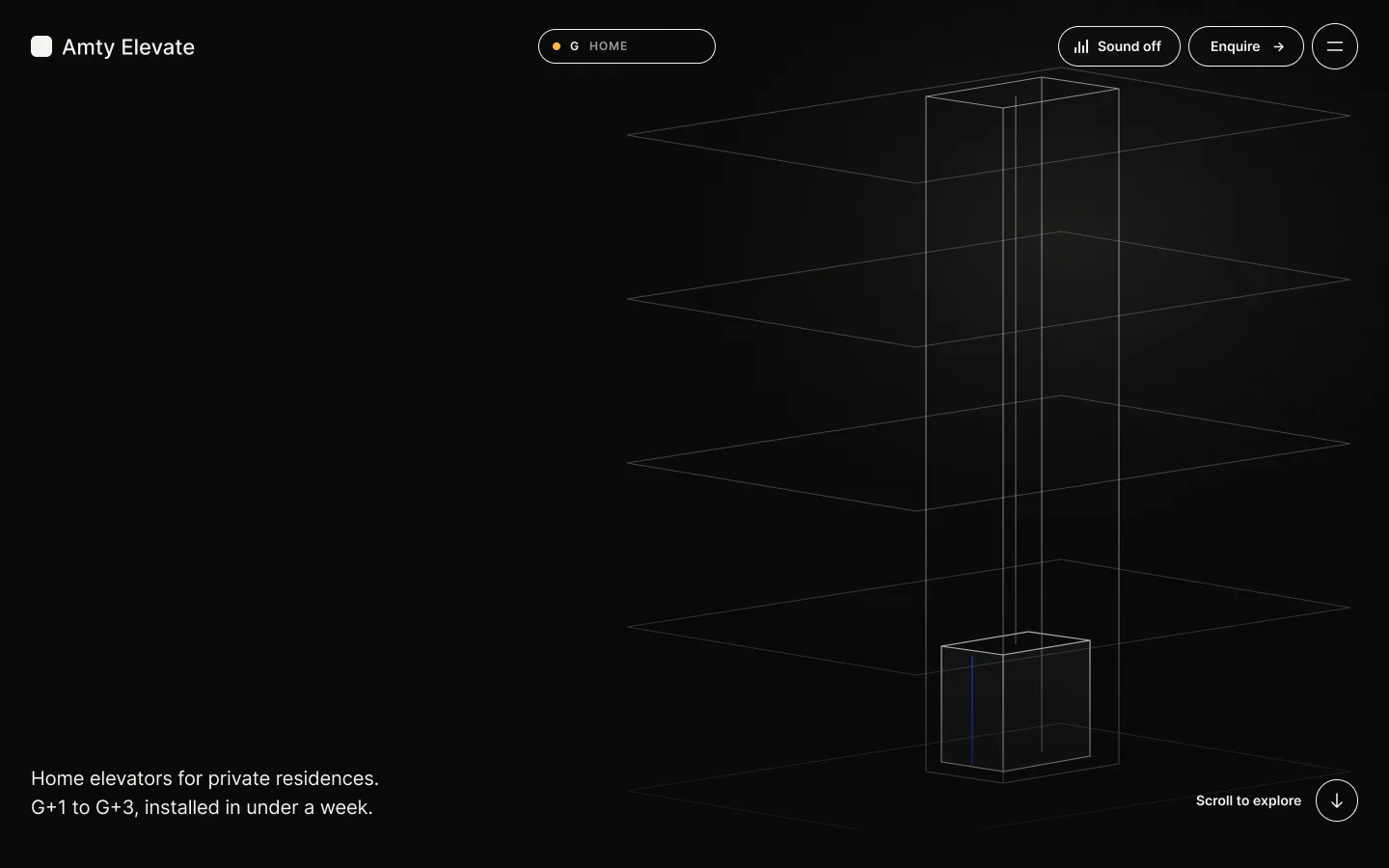
Amty Elevate, a home-lift brand · WebGL build in progress
- Studio
- New Delhi, India
- Works with
- Brands across India and abroad
- Built with
- Three.js, WebGL, GSAP, Blender
- Timeline
- 3 to 12 weeks
What studiokalex builds for brands across India
studiokalex is a design and engineering studio in New Delhi that designs and builds interactive 3D websites for brands across India. The 3D is real time: product scenes, scroll-driven stories and viewers rendered in the browser with Three.js and WebGL, on models we make in Blender.
Projects outside Delhi run remotely, on a shared board and a live staging link from the first week of build, with in-person reviews at the Delhi studio when they help. The same team designs the site, models the 3D and writes the code.
Four kinds of 3D website we build
- 01
A 3D hero scene on your current site
One real-time scene, usually the product, added to a site you already have. It takes 3 to 5 weeks and leaves the rest of the site alone.
- 02
A scroll-driven 3D story
A product or space that rotates, assembles or moves as the visitor scrolls, timed with GSAP to the copy beside it.
- 03
Product viewers
Visitors turn and zoom the product in the browser, and the same model opens in AR Quick Look on an iPhone.
- 04
A full 3D website
Every page designed around its 3D moments, with copy your team edits in Sanity. It takes 8 to 12 weeks.
Built for the phones India actually uses
Android carries about 93% of mobile web traffic in India, according to StatCounter's June 2026 figures. So every 3D scene we build is tested on a mid-range Android phone before launch: models are compressed with Draco or Meshopt, textures are kept small, and each scene loads only when it scrolls into view.
We build to Google's Core Web Vitals: the largest element painted within 2.5 seconds, a response to each tap within 200 milliseconds and layout shift under 0.1. A scene that can't meet them on a phone is simplified, and phones without WebGL get a designed still or video instead of a blank box.
When 3D is worth it, and when it isn't
3D earns its place when it shows something a photo can't: a product the buyer wants to turn over, a space that isn't built yet, or a mechanism that's hard to describe. For Indian brands that tends to mean product launches, real estate and interiors, furniture and home goods, and consumer hardware.
If the visitor only needs to watch, a well-compressed video is lighter than any 3D scene, and we will recommend it. Cost depends mostly on how many scenes and how much modelling the site needs; our guide to 3D website costs in India sets out the market ranges, and every project gets a fixed quote after a free intro call.
From storyboard to launch in about ten weeks
- Week 1
Storyboard
What the 3D has to show, page by page, and what stays as plain copy.
- Weeks 2–3
Design
Layouts in Figma, with each 3D moment marked frame by frame.
- Weeks 3–9
Model & build
Blender models, then Three.js scenes on a live staging link you can open anywhere.
- Weeks 9–10
Optimise & launch
Compression, fallbacks and Core Web Vitals on a mid-range phone, then handover.
3D websites in India: common questions
View all FAQsstudiokalex, a design and engineering studio in New Delhi, designs and builds interactive 3D websites with Three.js, WebGL and GSAP for brands across India, and models the 3D in-house in Blender. Projects outside Delhi run remotely on a shared board and a live staging link.
Yes. The work runs remotely: a shared board with every task and owner, a written update at the end of each working day, a daily window for live calls and a staging link you can open from the first week of build. In-person reviews at the Delhi studio are there if you want them.
A 3D hero scene on an existing site takes 3 to 5 weeks. A full 3D website with a CMS takes 8 to 12 weeks, covering the storyboard, design, modelling, development and performance work.
It should, and we test that it does. Every scene is checked on a mid-range Android phone before launch, models are compressed with Draco or Meshopt, and scenes load only when they scroll into view. Phones that can't run WebGL get a designed still or video of the same scene.
Yes, when it's built the right way. Headlines, copy and product details live in the server-rendered HTML and the 3D illustrates them, so search engines and AI assistants read everything without running WebGL.
Yes. We model products and spaces in Blender from CAD files, drawings or the physical sample. The same model is used for the website, for photoreal renders and for product films, so nothing is built twice.